Surprised by Joy
(William Wordsworth)
October 4, 2017 9:45 AM
I doubt if the effect of witnessing a total eclipse ever quite passes away. The impression is singularly vivid and quieting for days, and can never be wholly lost. A startling nearness to the gigantic forces of nature and their inconceivable operation seems to have been established. Personalities and towns and cities, and hates and jealousies, and even mundane hopes, grow very small and very far away. (Helen MacDonald, New York Times, 8.22.17)
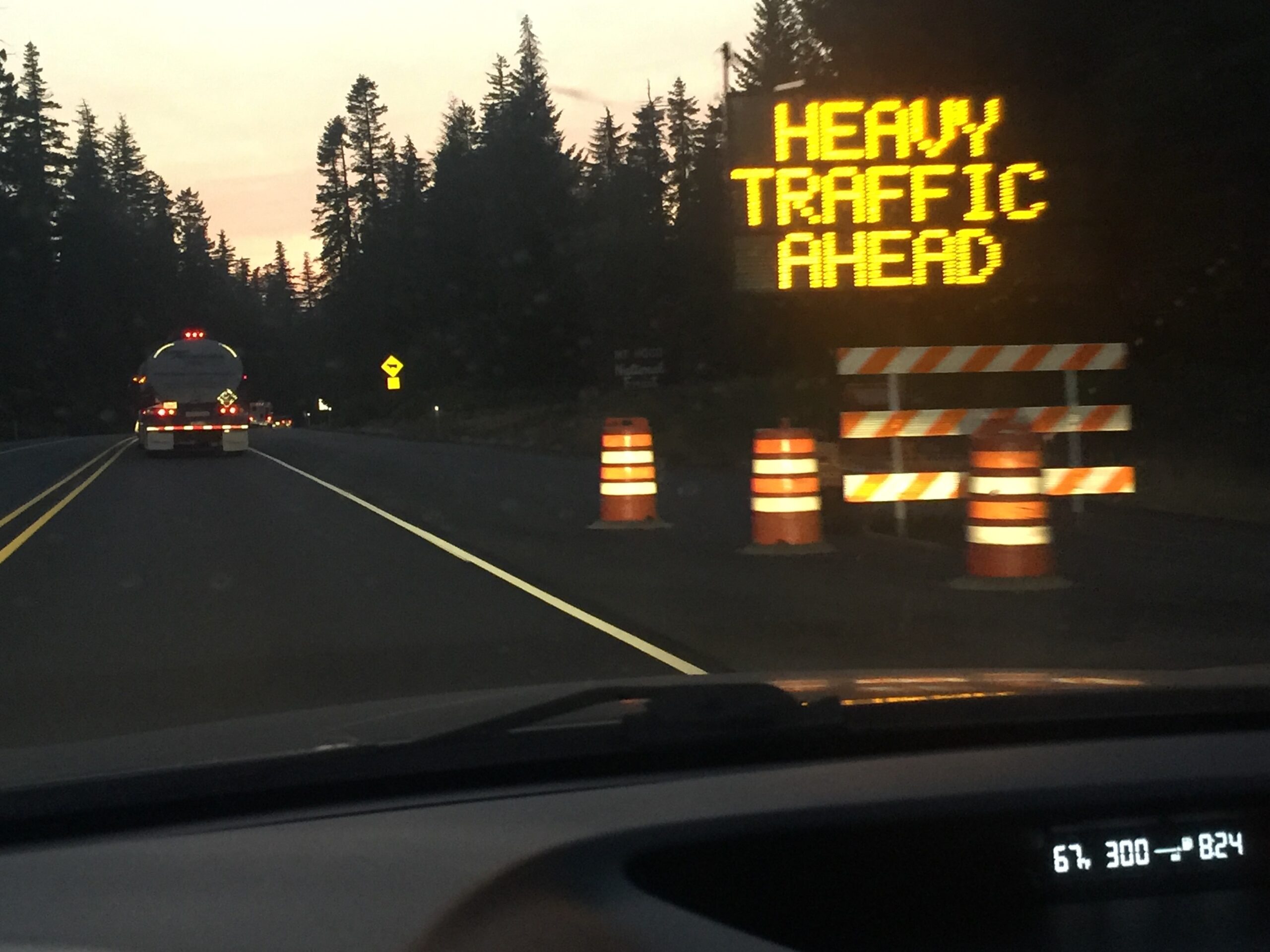
Returning. Highway 26 headed west toward Mount Hood: Midnight, August 22, 2017
What’s the most comfortable way to drive through the night for hours and hours within a massive, historic, and very slow moving horde of vehicles?
Fifteen or twenty miles an hour is a very different driving aesthetic and there’s not much in the way of driving tasks. Delightfully, it’s essentially the mental demands of being on a couch, vegetating.
I’m comfortably behind an oil truck, with no traffic coming the other direction. As the truck goes, I go. An excellent system for almost complete non-attention.
The only interruption to my reverie is the occasional ache in my right foot from the endless slight pushes to the accelerator. So I’m not in total and complete comfort. We go from stop-and-go to sort-of-go. I experiment with socks, no socks, shoes with no socks.
The seat is tilted way back and I’m remembering how much I love driving at slow speeds in cars at night. Music has greater meaning and emotion, and for some reason I find pleasure at the odd sense of seemingly being a part of – and within – this car/object with its instrument panel glowing with its unnatural, striking colors.
It’s that sublime “betweenedness.” I’ve felt it before looking out of airplane windows seats in late afternoons on the non-setting sun side. Yes, I’m from somewhere. I’m someone. I’m going somewhere. Maybe I’ve been somewhere.
But this right here, this car now, this is nowhere, and this is a special kind of place that can offer profound sensations if one can find the openings to enter.
I’m moving along with my cadre, which at this moment feels like the whole rest of the world.
To the west
About 20 seconds before totality, I had read that I should look west for something that might happen. Other than the word “shadow,” this something was not remotely known to me, but for three days I’d been riding a bike on country roads criss-crossing a vast desert plain sitting under Mount Jefferson, and it was towards the west and this beautiful mountain object that I now looked.
The volcano went dark, and then there was this movement – a huge movement – of darkness coming right at me across the plain.
There were no thoughts of “Oh my god, what is that?!!!! ” Nor was there an excited “I know what this is, I read about it, it’s the shadow of the moon moving towards us at 1,800 miles an hour as the total eclipse is about to happen!!!!”
I didn’t know what this was because I wasn’t within a mode of experience that was related to knowing anything. Whatever I thought was supposed to happen though the conventions of reading about it, or reading the science of it, or hearing descriptions from others, none of this ultimately had bearing whatsoever to the experience of it.
I was overtaken and entered a big and un-nameable context. As that shadow came towards me I shifted to a different, almost animal state with no sense of “I”.
We can’t talk much about bat or whale or meerkat consciousness because we aren’t those creatures. But looking back, I seemed more like one of them at that moment.
I turned toward back towards the sun above and to the east.
Cows, heat, and sarong-wrapped women with baskets on their heads
In 1987, I got out of an airplane in Kathmandu. We had landed, and I was uncomfortably dozing from two days of flu or food poisoning after an aborted flight the day before from Bangkok had us landing in Calcutta and then returning all the way to Bangkok due to a big storm in Nepal.
But here we now were, and I entered a terminal of filth, dilapidation, and yet, a great wonder of exciting weirdness.
I was directed to a room with holes in the floor, and threw up until my insides hurt. I went back out and as we walked outside I was immediately dragged far, far out of myself by what was in front of me.
After years of pictures and videos of life in far off places like Nepal, I remember being utterly unbelieving that what I was looking at and hearing and smelling and taking in actually existed. After all, it was just life going down the street in Kathmandu. But it was all ultimately unimaginable until it was in right front of me, there, in the air of it all.
I was transfixed and had no words. I was outside of myself.
(Non totality) bears almost no relation to a total eclipse. Seeing a partial eclipse bears the same relation to seeing a total eclipse as kissing a man does to marrying him, or as flying in an airplane does to falling out of an airplane. Although the one experience precedes the other, it in no way prepares you for it. (Annie Dillard’s “Total Eclipse”)
Saved by the fact that I happened to grab six bungee cords, decent tent stakes, and a mallet
It took eight hours to drive from Seattle to Madras, Oregon, and there I was at my spot in a field at “Solartown,” hosted by the Madras Chamber of Commerce. 20 by 20 feet barely allows a car and tent. I was here early, and by 2:00 PM I was set up. I figured out how to stretch a tarp with bungee-cords from my car to the tent for a small bit of shade, allowing room for one person sitting in his little chair.
No one was near me.
I just stand there, completely and utterly flummoxed, blasted by the desert heat. “What is this? Why did I do this? What do I do now? This is bad.” I deflate.
I’m hot, really hot. And there is nothing I can do about it. Other people in the near-distance have these sun canopies. I got one from Amazon three weeks before but it looked like such a pain in the ass to put up that I sent it back, driven by that laziness of mine that arises in relation to imagined physical work of almost any kind.
I’m irritated with myself about this.
I look around. They’ve figured out how to place porto-potties at these big events so that small lines of them are everywhere and in every direction. There is line-up of them right near me and I go into one, and find myself interested in the contents of the fresh, clean blue liquid in the “empty” bowl as I pee into it. It smells nice inside.
Non-totality
Enthusiastic reports about varieties of profound and meaningful experiences provoke me, and the eclipse is special in this regard. For years I carried a sense that a full solar eclipse was a transcendent experience for many.
The massive media attention about the coming “Great American Eclipse” pointed to something profound for those within the path of totality, that tiny period in which the moon completely covers the sun. But we also knew that a partial eclipse could be seen by almost everyone, and that there were rewards for that experience, too.
For days I had been getting texts and e-mails from friends and family who were excited about this coming experience from their vantage point of non-totality. These two experiences – pre-totality and totality – came to carry deeper and deeper distinctions for me and I wondered why.
When I got back to Seattle, others described their enthusiasm for their own partial eclipse experience. I started to feel that my descriptions of the mid-bending, overwhelming, ineffable aspects of totality were a rebuke. I was diminishing the senses others had felt. I started to avoid expressing my enthusiasm with its implied message “No, you really didn’t see IT.”
Seattle saw 92% of the sun covered, an occasion itself worthy of excitement and interest. Most of us have never looked directly at the sun, and watching the slow movement of the moon creating an ever-smaller crescent sun is dramatic. As greater percentages of the sun became covered, the temperature cools, shadows became sharper, and the light dims. There are beautiful and subtle changes to behold.
This roughly 80 minutes of partial totality on each side of full totality was a delight for me. The dark glasses allowed me to look at and be with the sun, which I had never done. But even at 99% coverage, the sun was itself, damaging to the eyes even for moment without the special glasses. The world was still itself.
Being here distances us from the bigger world, but it seeps in.
Across the way, a couple has arrived, and they pitch an elaborate tent and cooking area. I walk over, say hi, and compliment them on their dark green Subaru Outback. “I love that color.” We laugh about some things, talk for a bit. They like me and I like them.
The next day, I see them in a frenzy, pulling things out of their tent. I hear her stressful voice, “We got to do what we got to do”, and they rush around dismantling gear, ultimately dragging this large, fully pitched tent towards another site off in the distance.
I walk over and hear an elaborate story that had unfolded while I was gone. A man had arrived and had taken a space next to them.
“He was really weird and seemed drunk and belligerent. All he took out of his car were two chairs and a set of boxes that he put on the ground. He drove off and we looked in the boxes and saw glass jars with some powder and, would you believe it, a pressure cooker. He seemed drunk or high. We went and got security and they came over and talked to him. He got mad but they checked his stuff and found nothing. Then he left, and he never came back last night, leaving that stuff you see over there. My husband is retired law enforcement. We’ve just got to all be vigilant these days. I’m sorry, but this Madras event is a perfect terrorist situation. We need to protect ourselves.”
For the next three days, I watched that spot. No guy.
Finally, he came back at 8:00 PM the day before the eclipse. I walked over as he loaded this stuff back into a perfectly clean, new Kia sub-compact. I introduced myself and he described a situation of being embarrassed and mad when security came that few days earlier. He had decided to leave his gear to secure his site and go hike and camp for a couple days.
So there we were in the twilight. “I think I’m going to leave tonight to see the eclipse from somewhere else. Can you believe, some people called the cops when I got here because they thought I had a bomb, and now I don’t feel right staying.” He seemed normal, maybe a loner, maybe he did have a drug or alcohol or mental problem.
He was so gratified that I had come over that at one point he said, “Maybe I should stay.” But after a few more minutes of talking, he had made his decision. “I’m glad you came over, but I think I am going to go.”
We took over the world
It cools down by about 6:30 in the evening, and I walk around. I’m struck by the materials and tools these animal bodies of ours have created and are using and enjoying and relying on. Most of the campsites are marvels of comfort – complexes of beautiful materials strung together and arranged into different systems of creative function.
Moving, eating, sleeping, sitting. Cars, tents, chairs, cookware. So, so many objects in so many forms of order. Exquisite materials and designs.
I’m destabilized by these realizations of how we have taken over the world. I’m shocked by this place. Walking the streets of Seattle I’m so embedded in the material world that I don’t even register it. But this temporary town on the prairie has me looking down from above at it, at us, at me.
We took the world away from everything else. We got whatever we wanted. It’s now “ours”, but not really, and we’ll have it in this way only for a while longer.
Madras on the Sunday before…..
I meander along on my bike through town. A large growling dog runs out and I speed away in an adrenaline fury, this scary creature on my heels. My heart pounds. Teeth and snout touch the back of my shoes but I outrun it. Then I shriek – and I mean shriek – back at people in the distance “Fuck you for ruining my day”.
A woman shouts back “I’m so, so sorry, sir.”
Shaking, I ride on. Then I think a lot about the honorific “sir.” I’m disconcerted. Their dog ran after an older man on his bike. My organism is changing and I feel it all the time. This game is going to be called on account of darkness, sooner than later. I’m 63.
I feel bad I that had screamed and sworn. And then I don’t, and wished I’d ridden back and ranted some more at them about people and their awful dogs.
Five minutes later I walk my bike down Madras’s main street, still agitated.
One section of town has a few stores with Hispanic people sitting outside next to bins of cold drinks and candy bars. The woman from whom I choose to buy a drink speaks no English, and I jump into my Spanish. A switch is flipped.
From anger and heat and dog fear to good will and lightness. Spanish! And I love these people with whom I struggle – all the while in great spirits – to talk.
Something shifts inside me and I get happy. I walk down the traffic-packed street drinking my drink within a mellowness flowing from the pleasure of that Spanish interaction.
I think.
As I get older, what can I still get better at? What goals can I have that can be fun and rewarding? Someone wrote something somewhere about taking up tennis seriously at 55, only for the purpose of getting better. He wrote beautifully of the accumulated pleasures and meaning during the subsequent years of his tennis playing.
I read that people asked Pablo Casals about why he still practiced the cello at 90. “To get better.”
I think about Spanish. I think about guitar. I think about my relationship with Ann, with friends, with my kids and family. What kinds of pleasures and senses of artfulness still await, were I to really work on these?
Eclipses are properly sublime events in the philosophical sense: That is, they are an encounter with something so astonishing and terrifying that you lose all capacity for reason. Only afterward is it possible to speak lucidly of what you have seen. (Helen MacDonald, New York Times, 7.22.17)
I get back to Solartown
There’s my Subaru and tent and with my bike visible in front of the car on its side. There now are 7,000 people here.
When I left in the morning, I had a great talk with some neighbors, retired professors from Berkeley who had driven up. As I we talked and they realized my astronomy interests, I heard about their daughter, working on a post-doc at MIT in the physics of red stars. She would be arriving with friends and their husbands later. These were some very proud parents.
And now the whole group was there, sitting in beach chairs in a circle, and I was introduced. Oddly, there was an exception to the warm hellos. The husband of the daughter did not look up or remotely acknowledge me, and this in response to my friendly, “Hi John.” I registered an immediate sense of something upsetting to me.
The next morning, I walked around to the back of my car and this daughter and “John” were standing there. To my friendly “good morning” – not too enthusiastic or muted – he again completely ignored me. The daughter was friendly and normal.
How bothered I was by this! And then, I became bothered that I was so bothered. I noticed that when I returned after my bike ride, I felt so unwelcome that I didn’t say hello to any of them. What is wrong with me?
I sat in my chair in the boiling heat under my tarp dousing my head with a washcloth of ice water. I thought about this person next door. And I realized that my whole life has had as one little, but glorious benefit of me being generally immediately liked and responded to. How dare someone not grant me this right I’ve come to expect?
Yet, I’ve also trained myself to be aware of the faulty inferences we make about the behavior of others. Maybe John’s sister just had a cancer diagnosis. Maybe John has a depression problem. Maybe he doesn’t feel the obligation to be friendly like I do. What if I reminded him of a different event in his past, where some single older man crashed and ruined a party at some campground where he sat with his friends?
I had heard he was a wildlife biologist, and that they had gone to Smith Rock State Park to hike. The river there is famous for fresh water otters, and I was so obsessed by the need to prevail in connecting or understanding this guy that I walked right up to him the next morning and asked if he had seen the otters, and how he liked the trail. He responded briefly, evenly, thoughtfully.
And I felt it right there. He was just a guy. A guy with his own temperament. We had nothing to do with each other.
“You should think on this”, I said to myself.
Saturn and the Andromeda galaxy
Solartown was filled with telescopes and amateur astronomers. On two of the nights, I found people with good gear and groups of strangers hovering around having fun being taught about various celestial objects.
We looked at Andromeda, which means looking out of our own galaxy towards our sister galaxy, an object in the sky from which the light has been travelling for 2.3 million years to get here. People are fascinated and interested by Andromeda. With a good telescope and the ability to calm oneself to see it properly, it is profound. But profound in an abstract way requiring thinking and reflection.
Then I thought of when I first saw Saturn years earlier. The hundred pictures of Saturn seen since I was five didn’t remotely prepare me for seeing it the first time through a telescope. Suddenly it existed. There were the rings, and I couldn’t believe what I was looking at.
To me, seeing Saturn was a different kind of experience than Andromeda. But I wasn’t sure why.
I walked back to the tent that night thinking about all those kinds of experiences that pull you out of yourself. So many varieties. So I had seen Saturn. Then I remembered hanging off a boat in Hawaii at night while twelve foot manta rays looped by me, inches away. I thought about waking up to three inches of snow at the bottom of the Grand Canyon on a sunny morning and looking up 5,000 feet to the rim. I remembered Nepal in 1987.
But these experiences are ultimately a part of this world and the many aesthetic realms that trigger wonder and the senses of aliveness. And not just the natural world. Moments within relationships. The arts. Babies being born. Acts of goodness.
I drove all the way here to see the eclipse. And so did all these other people. Was this just another vacation to a new experience?
You have seen photographs of the sun taken during a total eclipse. The corona fills the print. All of those photographs were taken through telescopes. The lenses of telescopes and cameras can no more cover the breadth and scale of the visual array than language can cover the breadth and simultaneity of internal experience. Lenses enlarge the sight, omit its context, and make of it a pretty and sensible picture, like something on a Christmas card.
We take ourselves wherever we go
The saving grace in my planning for this trip was taking my bike. I ride on beautiful empty country roads that have been blocked off so that the massive number of arriving cars can’t sneak around the main highways to get into or through Madras.
Son Jack, age 20, was to accompany me here, and we had been excited about it for months. But right before leaving, he decided not to come.
The causes of tough times with children can be completely baffling. In this case there had been harsh words and cold interactions on both our parts around the process of completing a housing application and a written room-mate assessment as he prepared to return to college. The bad feelings were serious enough that Jack invited me to accompany him to his therapist of several years, Michael Berni. I was impressed and gratified at this invitation from Jack.
There is an almost impossible threading of the needle in parenting a young person like Jack. He needs and asks for help, but at this age there is the constant question of when and where as a parent I should engage or let go. Jack’s history includes occasional, but serious emotional distresses that have created fear in me and worries about his safety when they happen. Elements within our interactions in those days before leaving for Madras triggered bad intuitions regarding what might happen when Jack returned to school.
The counseling session was worse than terrible. I arrived with one intention, to understand Jack’s experiences of the previous days, and to acknowledge them. Listen to him and ask him if I got it right. Were there ways to do it better next time?
Within the counseling session Jack was mature, even-handed and thoughtful. But as we proceeded, I found myself overwhelmed first by dislike and then by what can only be described as hatred as I observed Berni’s interactions with us.
Obsession
I ride along, thinking about this awful Berni person. Within this hugely beautiful landscape, here I am, angry and ruminating on memories of his laziness and condescension as he stretched back in his chair, making comments that were completely abstracted from the actual work Jack and I were doing in communicating with each other.
What a great pride I sensed behind his clever intellect and formulations. There was no interest and attention in caring for us. I reviewed these memories of his persona, and, as I ride, I develop what is almost a transcript of the therapeutic violations I experienced. A narrative of unjustness.
I have these epiphanies about conflict, emotion, and why the world can be so distressing. Within all of the rhetoric I believe in about acceptance as a stance towards the world, right now I’m experiencing hatred.
And then I am longer in Oregon on a bike. I’m oblivious, running various mental loops over and over. I go back and tell Berni off, setting him straight as only I can do. He feels terrible and apologizes. Or, he arrogantly fights back, gaining ground with his expertise. I continue to hammer my points home at him, but I get madder and madder as I realize I’m not going to get the result I want.
I stop a moment on the road and take off my helmet, drape it on the handlebar and get back on. There aren’t any cars and I’m brought back for a moment to the breeze and being here. Two women ride by and one shouts, “Put on your helmet!” Give me a break. But, strangely, I put the helmet back on in my deference to that fleeting authority that just sped by.
I regress to my ruminations, imagining how I might hurt Berni’s business as a therapist. Is he rated on Yelp? I’ll write a scathing analysis in which the reader marvels at my insights. And then I further devolve, imagining finding his car, scratching it deeply with my keys, maybe breaking a window and speeding off.
Oh, the awfulness of him. But is he really a bad person? A morally compromised person practicing his craft with no integrity? If I were to go tell him off, or even just talk to him, would I walk out satisfied? These kinds of imagined interactions never go the way we think they will. I know myself, and the odds are high that I would only be left with regrets, senses of miscalculation, embarrassment, and a probable sensation that he is only a fellow human being who was being himself.
I ride on, upset at these opposing and competing emotions. Stop it, I think. What is this obsession with proving the legitimacy of my point of view? This is damaging me. Stop!
So I stop. It’s my kid. He’s been badly served. So have I. And then, who knows why, I just give it up. I ride by big, stacked boxes of swirling bees brought in to pollinate whatever is in these fields. I stop at a safe distance, turn, watch and feel my return to Oregon.
Back in the 19th century, scientists on eclipse-viewing expeditions saw them as a test of self-control. They were beset with anxiety that they might fail to maintain their objectivity in the face of the overwhelming emotions totality would bring. As the historian Alex Soojun-Kim Pang has described, their hands shook so much that many could barely record their data, and one observer was so overwhelmed by the 1871 eclipse in India that he was forced to retreat to his room and plunge his head into water. Charles Piazzi Smyth, the Edinburgh astronomer royal, wrote in surprise that during the eclipse of 1851, it was not just the “volatile Frenchman” who was “carried away in the impulses of the moment” but also the “staid Englishman” and the “stolid German.” (Helen MacDonald, New York Times, 7.22.17)
No essay written in 2017 can avoid “him”
There are continued hellos to neighbors, and we cover different kinds of ground. We’re excited. This is fun. We stand in different configurations, randomly moving across little topics. It’s a big community unified around something good that is coming.
And, of course within some short period of time we are always back to Trump. He has hijacked the minds of vast swatches of us. No conversation seems to be able to avoid him. He takes over, again and again. Later that day I read David Remnick in the New Yorker, and realize how drawn I am to a new art form, the poetry of indignation about Trump:
“This is the inescapable fact: on November 9th, the United States elected a dishonest, inept, unbalanced, and immoral human being as its President and Commander-in-Chief. Trump has daily proven unyielding to appeals of decency, unity, moderation, or fact. He is willing to imperil the civil peace and the social fabric of his country simply to satisfy his narcissism and to excite the worst inclinations of his core followers.” David Remnick (New Yorker, August, 2017)
These mentalities replicate themselves, and we seem only to be the vehicle. I find myself remembering that the “meme” metaphor’s original concept was drawn from Richard Dawkin’s seminal book The Selfish Gene. Genes replicate, and we as organisms are passive participants. And so it is proposed with respect to memes. They own us and replicate themselves, and culture is thereby transmitted.
I try to move the conversations to other topics than “him”. I need to manage my attention in different directions. But, later, as I read my New Yorker and use scarce phone battery power, I realize how beholden and drawn into this feeding and justifying of my indignation.
I TURN TOWARDS THE SUN
I pivot from the monstrous shadow that I had come from the west, take off the glasses, and there up in sky to the east is simply the most wondrous object I have ever, ever seen, and this within a giant, spellbinding environment.
I don’t seem to be registering it linguistically or analytically or rationally. I’m only there. I’m in some state of pre-intellectual awareness that seems only to come with those most powerful events that uncouple our frontal lobes and executive function. People in car accidents describe it well.
But a car accident is not a source of incomprehensible awe and wonder.
I’m within a completely alien atmosphere of space, color, sound, and movement. I fumble around, beside myself. It’s an alien beauty – a huge beauty – but not at all analogous to the other wondrous natural environments I have been in.
It was only for two minutes. Within this tiny moment within my life I remember almost nothing, except two perfectly formed, large tears coming out of the outside corners of each of my eyes at the same moment. The outside corners.
This was the universe about which we have read so much and never before felt: the universe as a clockwork of loose spheres flung at stupefying, unauthorized speeds. How could anything moving so fast not crash, not veer from its orbit amok like a car out of control on a turn? We joined our places on the planet’s thin crust; it held. (Annie Dillard “Total Eclipse.”)
Well, there were a couple more noticings within those two minutes from the observing “me.” One was a conventional amazement that Venus was really right there, near this “object” as it always, always is and will be. But this was the middle of the day!
And the entire horizon – 360 degrees – was in sunset. But what kind of sunset was this? It wasn’t dark, and it wasn’t twilight. It was a slightly, lightly lit world – a world that could never be imagined until one was within it. It seemed silent and quiet, but people were also making many sounds.
The sun emerged and I snapped back to standing on Earth.
And then it was done. A bead of sun re-appeared, and within what seemed almost a nothing of time the world returned and the glasses went back on.
I stood there, not sure what to do or be. Around me were smiling, exclaiming, tearful, dazed people. Parent voices were instructing kids to put their glasses back on.
I went and sat under the shade of a huge tent that had been constructed near the food vendors. I saw a headline in the New York Times and a reference to people who study awe as its own special emotion; one that seems to diminish senses of the individual self along with enhancing social behavior.
Everyone was talking to everyone. I talked to five different groups of people, and in every case, someone in the group started crying as they remembering those two little minutes.
And for the next few days, I couldn’t stop myself from grinning, remembering. There was an arising of smiling, coming out of nowhere. As I write this, I smile deeply.