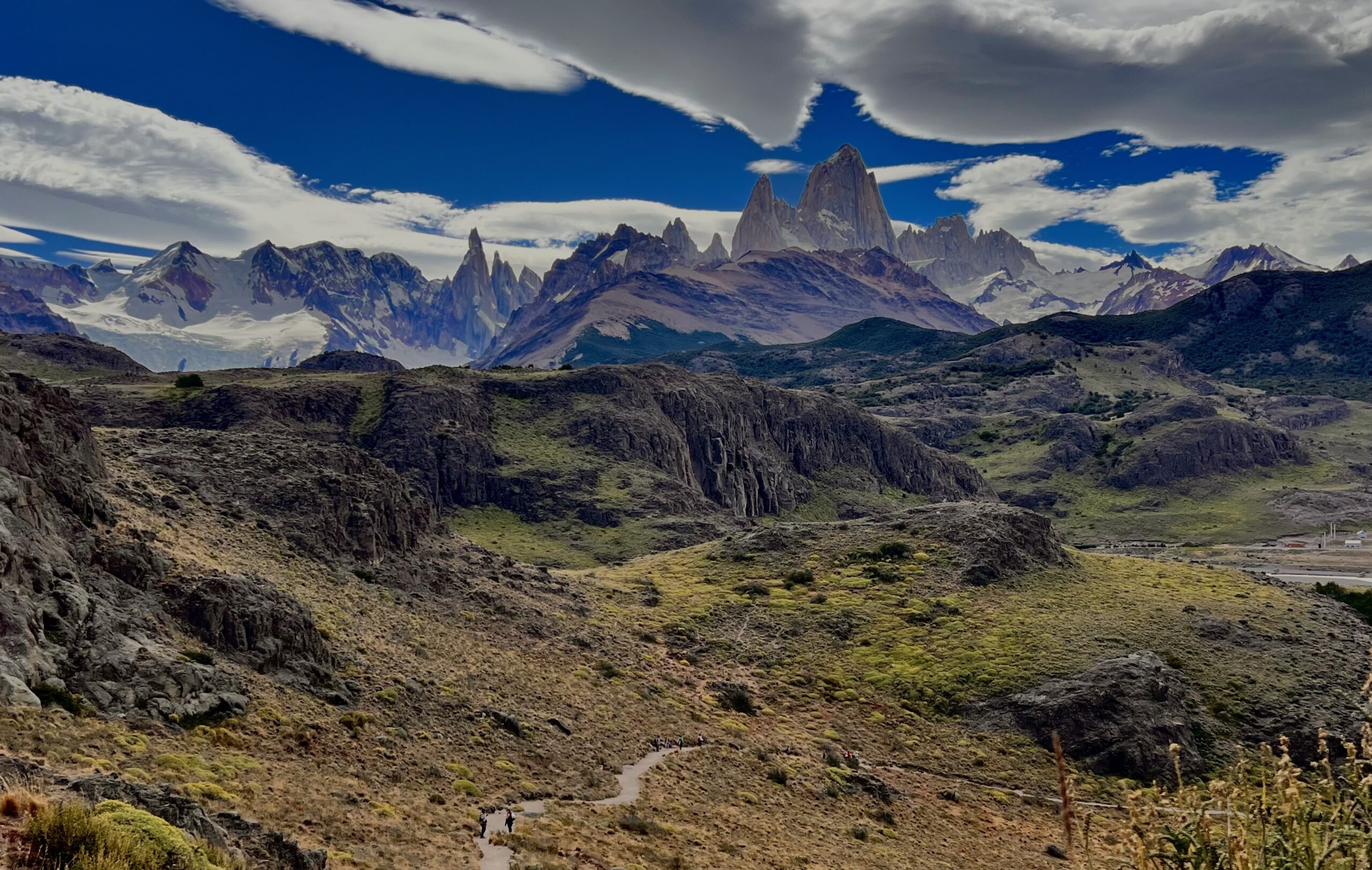
Cerro Torre, rising 10,262 feet (3,128 meters) above the glaciers of southern Patagonia on the Argentina–Chile border, is one of the most spectacular and notoriously difficult mountains on Earth. In the photo, it sits as one of three little spikes to the left of Fitzroy. Its almost vertical granite walls rise like a stone needle into a region battered by some of the fiercest winds on the planet. Unlike Everest, whose principal challenge involves extreme altitude, Cerro Torre demands extraordinarily difficult technical climbing on steep rock, ice, and mixed terrain. Violent Pacific storms can arrive with little warning, coating the rock in ice and making climbing impossible for days or weeks. Its summit is frequently crowned by an enormous, overhanging mushroom of rime ice, sculpted by wind-driven moisture into fantastically unstable formations. Even after overcoming thousands of feet of nearly vertical climbing, mountaineers must negotiate this final frozen obstacle. The combination of extreme exposure, unpredictable weather, difficult granite, and treacherous ice has made Cerro Torre a legendary test of mountaineering skill.
The mountain’s climbing history is dominated by one of mountaineering’s greatest controversies. In 1959, Italian climber Cesare Maestri claimed to have reached the summit with Austrian Toni Egger, who died during their descent. The absence of convincing evidence, together with inconsistencies in Maestri’s account, eventually led much of the climbing community to reject his claim. Determined to silence his critics, Maestri returned in 1970 with an extraordinary piece of equipment: a gasoline-powered air compressor used to drill hundreds of expansion bolts directly into the granite. Rather than follow natural cracks and weaknesses, his expedition effectively manufactured a route up the southeast ridge, installing approximately 400 bolts. Maestri abandoned the compressor high on the mountain, where it remains as a rusting monument to the controversy. He also stopped below the final ice mushroom, never reaching the actual summit. Legendary mountaineer Reinhold Messner condemned the episode as the “murder of the impossible,” arguing that engineering a passage through an otherwise forbidding mountain violated the very spirit of alpinism. The first undisputed summit ascent finally came in 1974, when four Italian climbers led by Casimiro Ferrari conquered the west face.
The controversy erupted again in 2012 when two young climbers, Hayden Kennedy and Jason Kruk, climbed the southeast ridge largely without using Maestri’s artificial bolt ladder. During their descent, they removed approximately 125 of his bolts, igniting an international argument about climbing ethics, historical preservation, and whether anyone has the right to permanently alter a mountain. Some regarded their action as liberation, restoring Cerro Torre’s natural challenge; others considered it an arrogant destruction of climbing history. That same month, Austrian climber David Lama and partner Peter Ortner completed a remarkable free ascent of the southeast ridge, demonstrating that the mountain could indeed be climbed without relying on Maestri’s bolt ladders. Cerro Torre thus occupies a unique place in mountaineering: it is not merely one of the world’s most technically demanding summits, but a mountain that has forced generations of climbers to confront a profound question about their sport. Is the purpose of climbing to reach the summit by whatever means necessary, or to discover what is possible within the limits imposed by the mountain itself?